
The sun was barely peeking over the horizon when Carmelo said goodbye to his mother at his front door.
His father was already in the field, but the young man left with his blessing.
Behind him, Pedrosa de Duero was still waking up beneath the morning chill. Carmelo held in his hands the hope that that day would change his family's course forever.
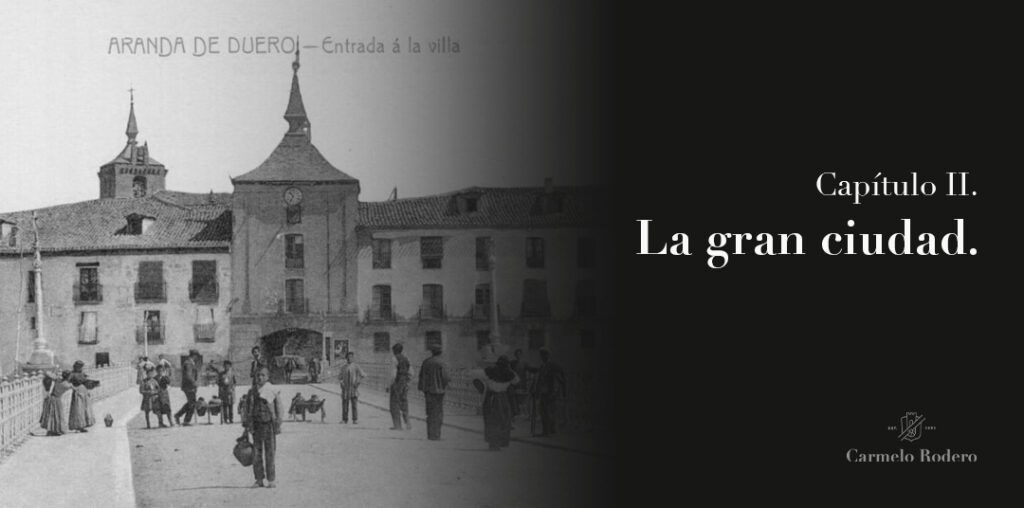
The bus that was to take him to Aranda de Duero, the largest village in the area was the only place where you could buy machinery.
I had been waiting for this moment all summer; he spent the harvesting days thinking about this moment.
At last.
The BU-120 road, which connected Pedrosa with Aranda, meandered through endless landscapes of cereal crops and vineyards, some already golden with autumn, others still in full production.
The distance, of about 25 kilometres, seemed small, but for Carmelo it was his first time alone on a bus heading into the city, a sort of border between her family life and the wider world and the unknown that he was beginning to discover.
The first village where the bus stopped was Roa, a village rooted in vine-growing, where a few passengers got on. Carmelo, sitting near the window, watched with curiosity the activity at each stop, the coming and going of elderly people, farmers and the odd young person heading to Aranda for reasons similar to his own: work, learning, progress.
The journey continued through Berlangas de Roa, where the bus made a brief stop. From his seat, Carmelo saw an elderly man with a flat cap and a walking stick get onto the bus, followed by a woman carrying a basket full of vegetables. He wondered if that old man had ever had dreams like his own, if he had ever imagined a future in which the children of the countryside could use machines to lighten their load.
He did imagine it, and that thought gave him strength to continue their journey.
After Berlangas, the landscape began to transform. The vineyards stretched beyond the horizon, but larger buildings, well-defined asphalt roads and denser traffic than what he was used to seeing also began to appear.
Aranda de Duero rose up before him like a kind of promise. Carmelo felt the emotion, the strong pounding of his chest as the bus drew closer to its destination.
At last, the vehicle arrived in the centre of Aranda, where the main stop was located. The tall buildings and paved streets felt like a different world to Pedrosa, but there was no time to waste. He stepped off the bus with firm strides and decided that, even though his heart was beating strongly in the face of the unknown, he would not let his nerves stop him.
I knew the John Deere agricultural machinery dealership was on the outskirts, in the trading estate, and that he would have to walk quite a distance to get there. He asked a couple of passers-by for the exact directions and set off. The path led him through the streets of central Aranda, which gradually gave way to wider, more deserted areas, with fewer people and more engine noise.
It was the first time he had found himself so close to factories and workshops, and he couldn't help noticing the huge buildings surrounding him.
Carmelo walked for more than half an hour until he reached the entrance to the industrial estate. Company signs appeared on large boards, and in the distance, glistening in the midday sun, he made out the green and yellow John Deere logo.
A smile spread across his face, knowing that he was about to enter a new chapter in his life.
The travel fatigue vanished upon walking through the showroom doors.
There, amongst tractors and modern machinery, Carmelo felt he had reached the first stage of his dream.
He knew that that was the beginning of something big for his family and, perhaps, for the way the land was farmed in his little corner of the Ribera del Duero.