
Winter in the Ribera del Duero it has an austere and profound beauty. When temperatures drop and the Duero winds sweep across the moors of Pedrosa de Duero, the vineyard it seems to plunge into an eternal lethargy. However, for us in Bodegas Carmelo Rodero, this is one of the most vibrant and decisive moments of the year.
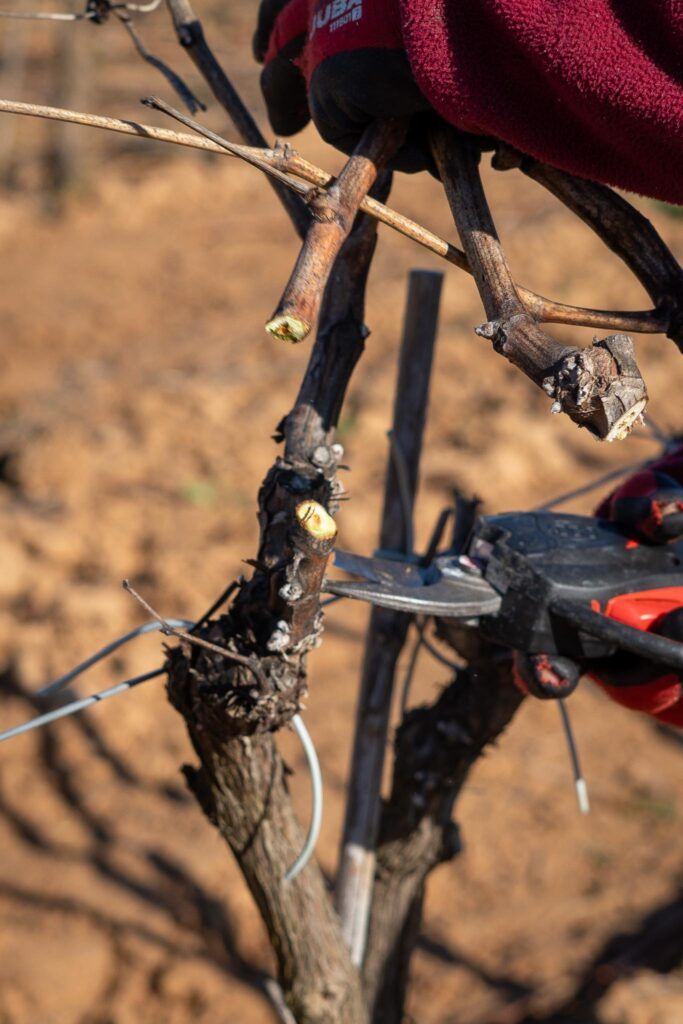
The winter pruning, also known as winter pruning, is the foundational act of every vintage. It is not simply a cleaning job; it is an intimate conversation between the winegrower and the vine. It is the moment when we decide, vine shoot by vine shoot, what kind of wine we want to bring to the glass in a few years' time.
1. Why prune? The search for the perfect balance
To understand pruning, we must first understand the nature of the grapevine. The Vitis vinifera It is, at its core, a climbing plant. If left to its own devices, it would dedicate all its energy to spreading out, creating metres and metres of wood and leaves in search of the light, but producing small, acidic and scattered fruit.
At Carmelo Rodero, our aim is the opposite: we are looking for concentration, typicity and elegance. Pruning is the tool that allows us to «tame» that wild vigour to channel the earth's energy towards quality.
The strategic benefits of pruning:
Production control: We limit the number of buds (the future shoots) to ensure the plant is not overloaded. A lower number of bunches means a greater concentration of polyphenols, sugars and aromas in each berry.
Plant architecture: We design the vine canopy structure so that, during the summer, the bunches get just the right amount of sun exposure and natural ventilation to protect them from diseases.
Vineyard age: Well-executed pruning respects the health of the wood. In our winery, we have plots of old vines that are true living monuments; their survival depends directly on the hand that prunes them every winter.
2. The time factor: Absolute rest
Pruning cannot begin until the vine enters what we call vegetative rest. Following the grape harvest, the plant begins to gather its reserves. The sap, which for months has nourished the fruit and leaves, descends towards the trunk and roots to protect itself from the frosts.
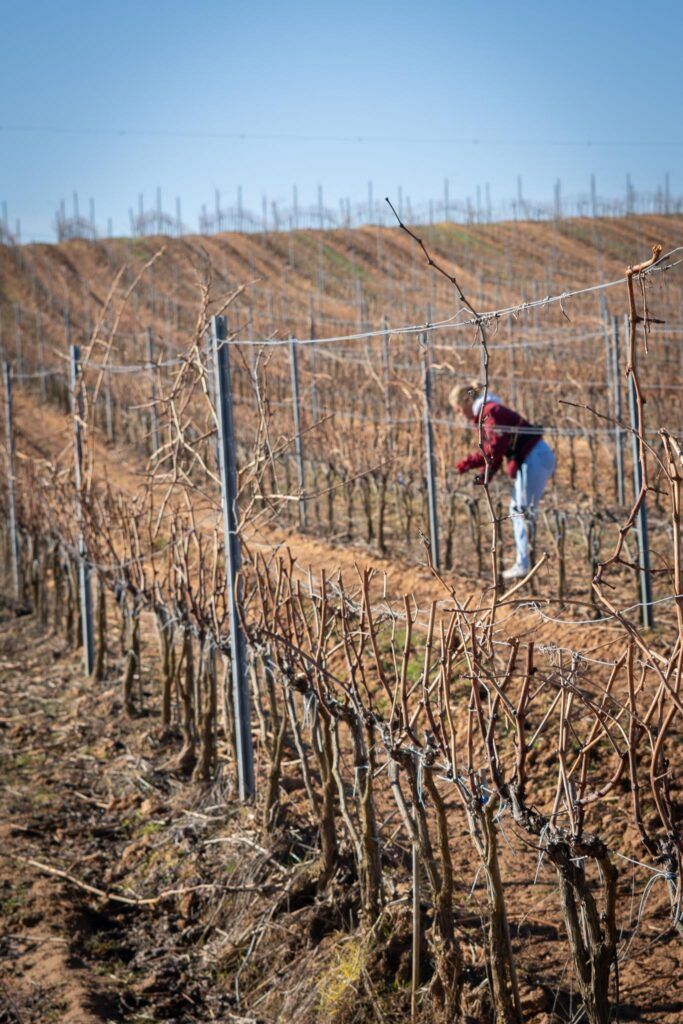
We wait until the leaves have completely fallen and the cold has settled in the Ribera. If we pruned too early, when the sap is still circulating, we would weaken the plant. Conversely, if we delay too long and the sap begins to rise, the famous «weeping of the vine» occurs, which although a sign of life, means a loss of energy if the cut is late. At Carmelo Rodero, the timing it is a science based on the daily observation of the weather and our plots.
3. Pruning techniques: Adapting to each Pago
Every vineyard is a world. Across our 140 hectares, we find vines of different ages and training systems that require specific approaches.
Bush Vine Pruning (Respecting tradition)
It is the oldest and most emblematic system in our area. The vines grow without the support of wires, forming a low structure with three or four arms.
- How to do it: The most vigorous and best-positioned vine shoots from the previous season are selected and cut, leaving Thumbs (short pieces with only two or three buds).
- The objective: Keep the plant close to the ground so that it can make the most of the heat that the clay-limestone soils of Pedrosa radiate during the night.
Trellis Pruning (Precision and Modernity)
For younger vineyards or those designed for precision viticulture, we use wire trellis systems. Here, the reigning technique is the Double Royat Cordon.
- The process: The vine has two permanent horizontal arms above the wire. On them, we leave equidistantly spaced spurs.
- The advantage: It allows for very careful mechanisation of certain tasks and ensures that all the bunches grow at the same height, receiving identical sunlight, which translates into extremely uniform ripening.
4. The Respectful Pruning: The hallmark of Carmelo Rodero
If anything defines the way we work, it is the respectful pruning or physiological pruning. In recent years, global viticulture has faced trunk diseases that threaten the life of the vines. In our winery, we have perfected a technique that minimises these risks.
The key elements of our methodology:
Respect the sap flows: We imagine the interior of the plant as a circulatory system. We never make cuts that interrupt the main flow of the vascular channels. If we «cut off» the sap's path, part of the arm will die, creating deadwood which is the gateway for fungi.
The Wood of Respect: When cutting an old vine shoot, we never cut it flush with the trunk. We leave a small piece of wood remaining (a «stub»). This allows the natural drying process to take place in that extra wood, and not inside the main trunk, protecting the heart of the vine.
Clean and small cuts: We prefer to intervene consistently and subtly every year rather than having to perform major surgeries that leave large, open wounds.
5. The team: Knowledge that is not written down is inherited
Despite all technological advances, there is no machine capable of replacing the human eye when facing a Tinta del País vine. Each plant is different: one may have more vigour, another may have suffered more from the water stress of the previous summer, and another may need to be «rejuvenated».
The viticulture team of Bodegas Carmelo Rodero It is made up of experts who have spent years, in some cases decades, walking among these very rows. That visual memory is fundamental. They know which arm produced the best grape last year and how to guide the plant to outdo itself this year.
Pruning is an exercise in future forecast. The pruner does not look at what he cuts, he looks at what he leaves behind. Every decision made in January will have a direct consequence on the October harvest and, ultimately, on the structure and ageing potential of our wines.
6. Sustainability through pruning
Pruning is also an essential part of our commitment to the environment. The pruning waste (the cut vine shoots) is not considered waste. At Carmelo Rodero, we usually shred these vine shoots right in the vineyard so that they are reincorporated into the soil as organic matter. It is a perfect cycle of return: what the plant extracted from the earth to grow goes back to it to nourish the next generation of shoots. This improves soil structure and reduces the need for external fertilisers, keeping the ecosystem in balance.
Conclusion: The rebirth that begins in the cold
When we finish the pruning and silence reigns once more in the vineyard, there remains a sense of a job well done. The vines now look bare, schematic, prepared to withstand what is left of winter.
Right, with the arrival of spring, we'll see the «I'm crying», that first drop of sap that wells up from the pruning cuts, telling us that the roots have woken up once again. At that moment, we will know that the design we traced with our shears in the coldest days of the year is beginning to take living shape.
In every bottle of Carmelo Rodero, from our Joven to the TSM or the Pago de Baltasar, there is a piece of this winter architecture. Because great wine is not made in the winery, but here, in the vineyard, beneath the Ribera sky, respecting the rhythm of nature and the legacy of a family dedicated to their land.